

2026 World Cup Stadiums
Take a look at the complete list of the 16 stadiums for the 2026 World Cup in the United States, Mexico, and Canada!
2026 World Cup Stadiums – m88worldcups.com – When talking about the World Cup, most people immediately think of the actions of star players on the field, spectacular goals, or dramatic moments that leave a lasting impression.
We might imagine a perfectly timed tackle in the dying minutes or a beautifully curved free kick finding the corner of the net.
However, behind all the euphoria and the roar of the crowd, there is one element that is no less important and often becomes a central character in the story of a tournament: the stadium.
Without the presence of adequate stadiums with high standards of safety and comfort, a tournament of this magnitude would not be able to run smoothly.
Stadiums are the theatrical stage where the drama of sport unfolds, and great infrastructure multiplies the quality of that drama many times over.
For the 2026 World Cup stadiums, the list of venues is truly extraordinary and stands at a different level compared to previous editions.
Almost all stadiums have massive capacities capable of accommodating tens of thousands of spectators, world-class facilities that cater to both VIP and general audiences, and architectural designs that captivate the world.
The 2026 World Cup itself will be a historic edition because, for the first time in FIFA history, the tournament will be hosted across three countries: the United States, Mexico, and Canada.
This decision was made to accommodate the expansion to 48 participating teams, which automatically requires more high-quality venues.
A total of 16 stadiums have been selected through a highly rigorous process, with each venue possessing its own character, spirit, and advantages.
From modern arenas in city centers equipped with advanced technology, historic stadiums rich in past memories, to venues with beautiful natural backdrops, all will serve as the stage for competition among the world’s best teams. Let us examine one by one the regional distribution and unique characteristics of each stadium in the host countries.
United States
As the primary host that will stage the majority of matches from the group stage to the final, the United States contributes the largest number of stadiums to the 2026 World Cup.
The country is known for having a highly advanced sports industry, making it unsurprising that the infrastructure offered is extremely ambitious.
Almost all of these stadiums are actually home venues for NFL (American Football) teams, meaning they are already accustomed to handling logistics and massive crowds on a weekly basis.
Their capacities are also remarkable, averaging above 65,000 spectators, with some even approaching an impressive figure of 83,000 seats.
Not only relying on their large size, these stadiums are also equipped with extremely comprehensive facilities that may be difficult to find in other parts of the world.
Features such as retractable roofs, ultra-high-resolution giant screens, and futuristic architectural designs will make the football viewing experience more impressive and unforgettable.
List of 2026 World Cup Stadiums in the United States
SoFi Stadium, Los Angeles, California: Capacity of 70,240 spectators. This stadium is often referred to as a masterpiece of modern architecture. Known as one of the most advanced stadiums in the world, SoFi features a 360-degree circular screen called “The Infinity Screen” suspended from the roof.
MetLife Stadium, New York City, New York: Holds up to 82,500 spectators. Located in East Rutherford, New Jersey, this stadium is home to two major NFL teams. With its massive capacity, MetLife is one of the largest stadiums in the 2026 World Cup and is expected to host crucial matches.
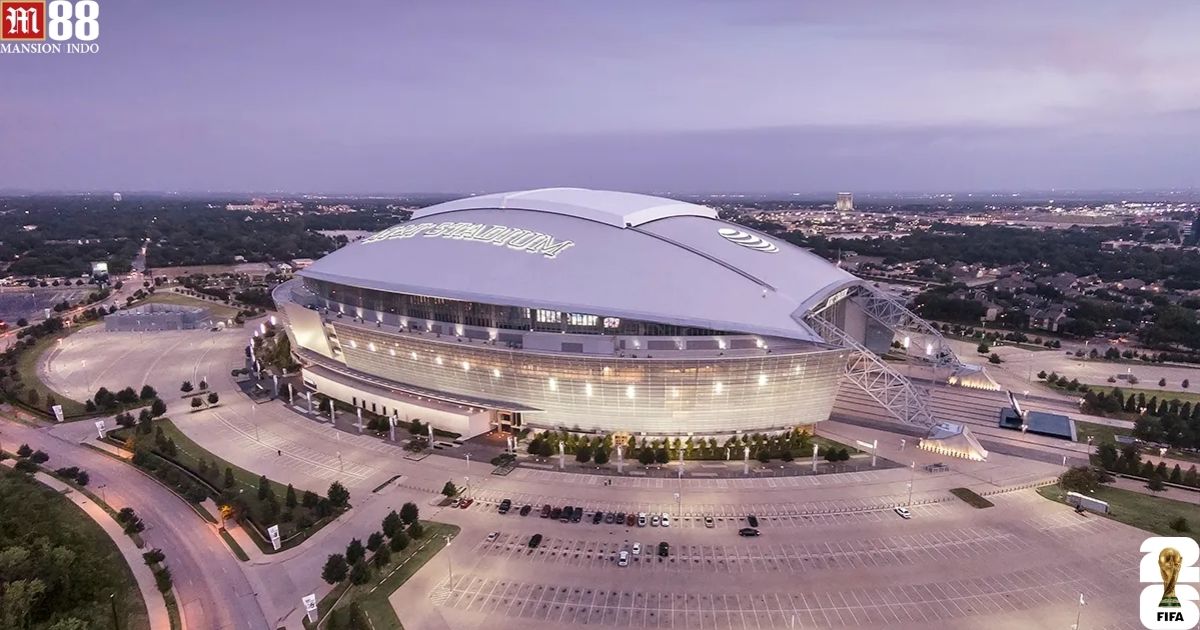
AT&T Stadium, Dallas, Texas: Capacity of 80,000 (expandable). This stadium features a roof that can adapt to weather conditions and a giant screen suspended in the center of the arena, providing clear viewing angles for all spectators.
Arrowhead Stadium, Kansas City, Missouri: Holds 76,416 spectators. This stadium holds the world record as the loudest stadium in the world. The support from fans here is guaranteed to intimidate opposing teams.
NRG Stadium, Houston, Texas: Capacity of 72,220 spectators. This venue is multifunctional and highly flexible for various sports and large-scale concerts, making it an ideal choice for international tournaments.
Mercedes-Benz Stadium, Atlanta, Georgia: Holds 75,000 spectators. Its most striking feature is the unique “blooming” roof design inspired by bird wings, which can fully open and close within a short time.
Lincoln Financial Field, Philadelphia, Pennsylvania: Capacity of 67,594 spectators. Known for its passionate and energetic fans, this stadium will provide additional energy for every match held there.
Lumen Field, Seattle, Washington: Has 68,740 seats. This stadium is known for its steep seating design, creating exceptional acoustic effects while offering beautiful views of the city of Seattle.
Levi’s Stadium, San Francisco, California: Capacity of 68,500 spectators. As the home of the San Francisco 49ers, this venue is recognized as one of the most environmentally friendly stadiums in the world due to its use of solar panels and advanced water recycling systems.
Gillette Stadium, Boston, Massachusetts: Holds 65,878 spectators. Its location is highly strategic as it is close to downtown Boston and has a long history of hosting major sporting events.
Hard Rock Stadium, Miami, Florida: Capacity of 65,326 spectators. This stadium has a strong tropical atmosphere and is frequently used for major tournament finals and concerts by world-renowned artists, promising an extraordinary spectacle.
Mexico
Mexico will make history as the first country to host the World Cup for the third time (after 1970 and 1986).
This time, they bring a very compelling combination: historic stadiums with deep “soul” and long-standing memories, as well as modern arenas ready to embrace the future.
Football in Mexico is not merely a sport, but a religion. Therefore, the atmosphere experienced by players and spectators here is guaranteed to be highly emotional.
The most iconic of all is Estadio Azteca, a football temple that has witnessed the greatness of Pele and Diego Maradona.
List of 2026 World Cup Stadiums in Mexico
Estadio Azteca, Mexico City: Capacity of 83,264 spectators. This is a legendary stadium, the only one in the world to have hosted the World Cup final twice. Playing here is a dream for many players due to its invaluable historical significance.
Estadio BBVA Bancomer, Monterrey, Nuevo Leon: Capacity of 53,500 seats. Often referred to as “The Steel Giant,” this stadium offers one of the most aesthetic views in the world, with the towering Cerro de la Silla mountains forming a dramatic backdrop behind the stands.
Estadio Akron, Guadalajara, Jalisco: Capacity of 46,355 spectators. Known for its futuristic design resembling an erupting volcano, this stadium is equipped with modern facilities that ensure maximum comfort for supporters.
Canada
Although it only has two stadiums in terms of numbers, Canada still makes a very important and strategic contribution.
Canada’s presence in this collaboration demonstrates that football has developed rapidly in the northern region.
Its stadiums offer distinctive scenery and a unique atmosphere different from venues in the United States and Mexico, with the characteristic hospitality of Canadian society.
List of 2026 World Cup Stadiums in Canada
BC Place, Vancouver, British Columbia: Capacity of 54,500 spectators. This stadium features a retractable cable roof system and offers stunning views of mountains and surrounding waters. It will be one of the most photogenic venues during the tournament.
BMO Field, Toronto, Ontario: Holds 40,000 spectators. Although it has the smallest capacity among the others, the stadium’s intimate design makes spectators feel very close to the action on the field, creating its own pressure for players on the pitch.
Closing: 2026 World Cup Stadiums as the Stage for Epic Battles
The combination of magnificent stadiums across three countries will serve as the perfect backdrop for the success of the 2026 World Cup.
We will not only be presented with high-level tactical matches, but also architectural grandeur that reflects the advancement of modern civilization.
From modern stadiums in the United States filled with cutting-edge technology and premium comfort, historic arenas in Mexico full of stories and passion, to Canadian stadiums that offer a different atmosphere and natural scenery, all are ready to create historic moments that will be remembered for generations.
With all the grandeur and thorough preparations from the three host countries, anticipation for the first whistle is already building.
These stadiums are not merely physical structures of steel and concrete, but vessels where the great dreams of world footballers will be contested for the highest honor. See you in the stands to witness history in the making.
Latest Article