2014 World Cup Controversies
From Suarez’s bite to Neymar’s injury, take a look at the list of 2014 World Cup controversies that shocked the football world!
2014 World Cup Controversies – m88worldcups.com – The 2014 World Cup in Brazil became one of the most memorable editions in football history.
From Germany’s victory over Argentina in the final to the outstanding performances of several players, this tournament truly delivered exciting and thrilling entertainment.
However, beyond the beautiful goals and heroic moments, the 2014 World Cup was also filled with controversies that became hot topics of discussion worldwide.
Several incidents showed that football does not always run smoothly and fairly.
Human error, questionable refereeing decisions, internal team conflicts, and social issues all played a role in shaping this tournament.
Here is a summary of the 2014 World Cup controversies that attracted the most public attention.
2014 World Cup Controversies That Caused a Stir
1. Luis Suarez Bites Giorgio Chiellini
Luis Suarez, who had previously been involved in biting incidents with Othman Bakkal and Branislav Ivanovic, once again created controversy at the 2014 World Cup. During Uruguay’s group-stage match against Italy, Suarez bit defender Giorgio Chiellini.
Although the referee did not immediately punish the incident, FIFA eventually handed Suarez a severe sanction in the form of a four-month ban from all football-related activities and a nine-match international suspension.
This incident sparked outrage from fans and media around the world, further adding to Suarez’s controversial reputation in the eyes of the public.
2. Referee Yuichi Nishimura
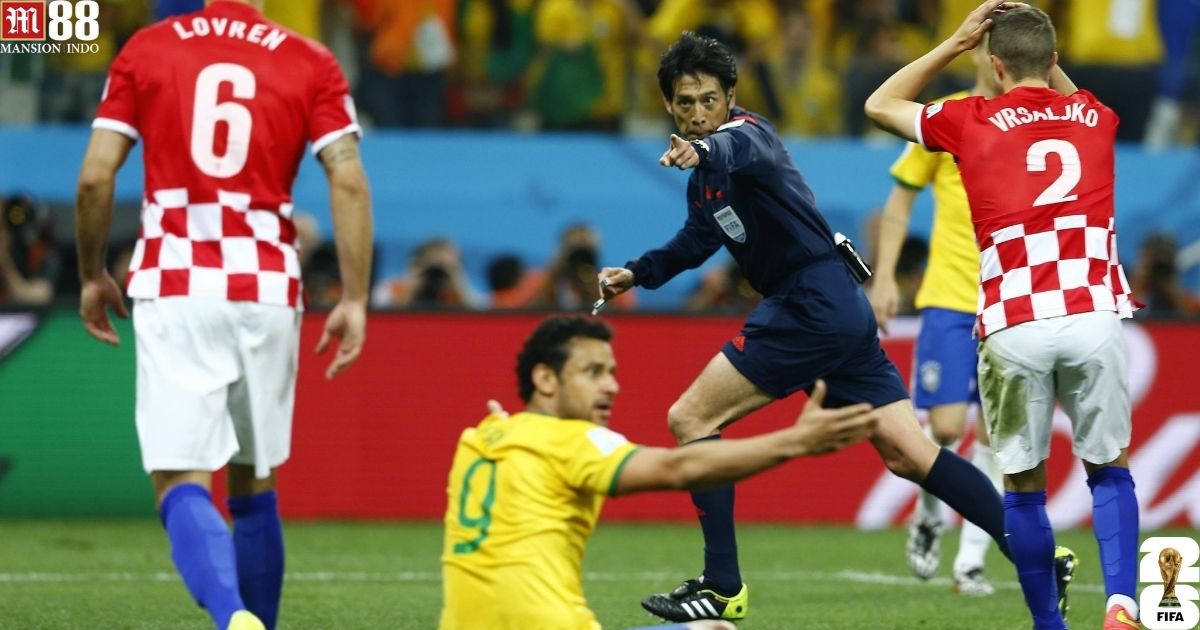
Controversy also emerged from the opening match between Brazil and Croatia. Japanese referee Yuichi Nishimura was considered biased after disallowing a Croatian goal and awarding Brazil a penalty after striker Fred went down.
Croatian players complained about poor communication, and it was even reported that Nishimura did not understand English well, which made the situation even more heated.
These refereeing decisions sparked long debates regarding objectivity and officiating standards in a tournament as prestigious as the World Cup.
3. Neymar’s Fractured Vertebra
The most dramatic incident occurred when Brazil striker Neymar was fouled by Colombia defender Juan Zuniga.
Zuniga’s knee struck Neymar forcefully, causing a fractured vertebra. The injury temporarily threatened Neymar’s career and could even have caused paralysis if it had occurred slightly closer to a vital area.
Zuniga escaped punishment, but the Brazilian public reacted with great anger. Brazil performed poorly in the remainder of the tournament without Neymar, scoring only one goal while conceding ten. This incident became one of the most horrifying and controversial moments of the 2014 World Cup.
4. 2014 World Cup Controversy: Public Protests in Brazil
The 2014 World Cup controversies had already begun even before the tournament started, as the Brazilian public staged massive demonstrations because they felt the government had spent too much money to host the competition.
These protests had already begun during the 2013 Confederations Cup, which served as a test event for tournament infrastructure and organization.
Brazilian President Dilma Rousseff and FIFA President Sepp Blatter were even booed during the opening ceremony.
As a result, FIFA decided not to hold official speeches during the opening of the 2014 World Cup.
These demonstrations reflected public dissatisfaction with the management of public funds and added a socio-political layer to the tournament.
5. Ghana National Team Chaos
The Ghana national team also came under the spotlight due to internal and financial problems. Players demanded bonuses during the tournament, forcing the Ghanaian government to send USD 3 million in cash by cargo plane to Brazil to prevent a player strike.
In addition, two senior players, Kevin-Prince Boateng and Sulley Muntari, were sent home before the final group-stage match for allegedly committing serious disciplinary violations, although Boateng claimed he was a victim of false accusations.
This incident highlighted poor team and football federation management in preparing the squad for the World Cup.
6. Tim Krul’s Psychological Tactics in the Penalty Shootout Against Costa Rica
In the Netherlands quarterfinal match against Costa Rica, coach Louis Van Gaal surprised the world by substituting goalkeeper Jasper Cillessen for Tim Krul just before the penalty shootout. The decision proved successful as Krul saved two Costa Rican penalties.
However, Krul’s intimidating behavior toward penalty takers was considered excessive. He used gestures and verbal comments to unsettle opponents, sparking debate about ethics and sportsmanship at the World Cup.
Senior referee Graham Poll stated that such actions should not occur and deserved a warning.
7. 2014 World Cup Controversy: Reduced Restrictions on Alcohol Sales in Stadiums
Controversy also emerged from sponsorship and local regulations. Brazil had previously banned alcohol sales inside stadiums, but FIFA demanded that Budweiser, the official World Cup sponsor, still be allowed to sell beer.
The Brazilian government eventually created a special law allowing alcohol sales during the tournament, commonly referred to as the “Budweiser Bill.”
Even so, the policy remained controversial because it involved local culture, fan safety, and sponsor influence.
Conclusion
The 2014 World Cup delivered spectacular football action, but it was also marked by controversies that were equally compelling.
From Suarez’s bite, questionable refereeing decisions, Neymar’s injury, to internal team conflicts and public protests, all of these incidents added drama to the tournament.
These controversies showed that the World Cup is not only about goals and trophies, but also about emotions, politics, and cultures colliding with one another.
Nevertheless, these controversial stories remain an important part of tournament history and ensure that the 2014 World Cup will always be remembered by football fans around the world.
Latest Article