
8 2022 World Cup Stadiums
Take a look at the grandeur of the 8 stadiums of the 2022 World Cup in Qatar.
2022 World Cup Stadiums – m88worldcups.com – When talking about football, aside from major leagues such as the Premier League in England or La Liga in Spain, there is one tournament that always becomes the center of global attention every four years.
Yes, it is none other than the FIFA World Cup. In 2022, Qatar had the opportunity to host the tournament.
Interestingly, this was the first time the World Cup was held in the Middle East and also the first to take place at the end of the year, specifically November–December.
The reason is simple, Qatar has extremely hot weather during the summer, so the schedule was shifted to winter to make it more comfortable for players and spectators.
However, what made it even more remarkable was not only the schedule, but also Qatar’s preparations. This small yet wealthy nation invested billions of dollars to build state-of-the-art facilities, including eight extraordinary stadiums.
These eight stadiums became the backbone of the biggest football celebration in the world, and each one has its own concept, design, and unique story.
Some designs are inspired by local culture, some are fully futuristic with modern cooling technology, and there is even a stadium that can be dismantled after the tournament.
To better understand how spectacular Qatar’s hosting was, let us explore each of the 2022 World Cup stadiums that amazed the world.
Prepare yourself, because the story is not only about football, but also about culture, architecture, and the sustainability of future development.
List of 2022 World Cup Stadiums
Qatar prepared eight main stadiums for the 2022 World Cup. The number may not be large, but the quality and uniqueness are exceptional.
Each stadium was built with extraordinary detail, combining modern technology with traditional values. The following is the complete list.
1. 2022 World Cup Stadium: Lusail Iconic Stadium
When discussing the most iconic stadium in Qatar, Lusail stands at the top. With a capacity of 86,250 seats, this stadium officially became the largest and served as the main venue, including the final match. It is located in Lusail City, approximately 15 km north of central Doha.
Its design is inspired by the play of light and shadow commonly seen in traditional Arab Fanar lanterns.
From the outside, the stadium appears extremely luxurious, resembling a masterpiece of modern architecture with a touch of traditional culture.
What makes it even more impressive is that after the World Cup, Lusail will not be left unused.
Its seats will be dismantled, and the stadium will be transformed into a community hub complete with schools, cafés, healthcare facilities, and sports centers.
Thus, this stadium was designed from the beginning to have a meaningful future for the surrounding community.
2. Khalifa International Stadium
Unlike Lusail, which was newly built, Khalifa International Stadium has a long history.
Constructed in 1976 in the Al-Rayyan area, this stadium has witnessed many major sporting events, including the Asian Games, Arabian Gulf Cup, and AFC Asian Cup.
For the World Cup, its capacity was increased to 40,000 seats, along with advanced cooling technology to maintain comfort.
The renovation also added a new roof covering part of the spectator area and additional facilities such as food courts, shops, and clinics.
Notably, Khalifa is the only 2022 World Cup stadium that will not be dismantled after the tournament.
Therefore, it will continue to serve as a sports icon in Qatar for future major events.
3. Stadium 974
This stadium can be considered the most unique. Built from 974 shipping containers, it immediately attracted global attention.
The number 974 represents not only the number of containers but also Qatar’s international dialing code. It is located along the Ras Bu Abboud waterfront and has a capacity of 40,000 spectators.
Its design is inspired by Qatar’s history of trade and maritime activity. Because most of its structure consists of containers, the stadium can be completely dismantled after the tournament.
This means Stadium 974 is a truly environmentally friendly temporary stadium.
In the future, the former site will be developed into a modern waterfront area for the local community.
4. 2022 World Cup Stadium: Education City Stadium
As the name suggests, this stadium is located in Education City in Al-Rayyan, known as a hub for education and innovation.
It has a capacity of 40,000 seats with a triangular design that reflects sunlight beautifully. From the outside, it resembles a gemstone, earning the nickname “Desert Diamond.”
Another unique feature is that the pitch is built slightly below ground level to create a cooler environment inside the stadium.
After the World Cup, its capacity will be reduced to 20,000 seats, and the remaining seats will be donated to developing countries in need of football stadiums.
Thus, this stadium not only serves entertainment purposes but also has a significant social impact.
5. Ahmad bin Ali Stadium
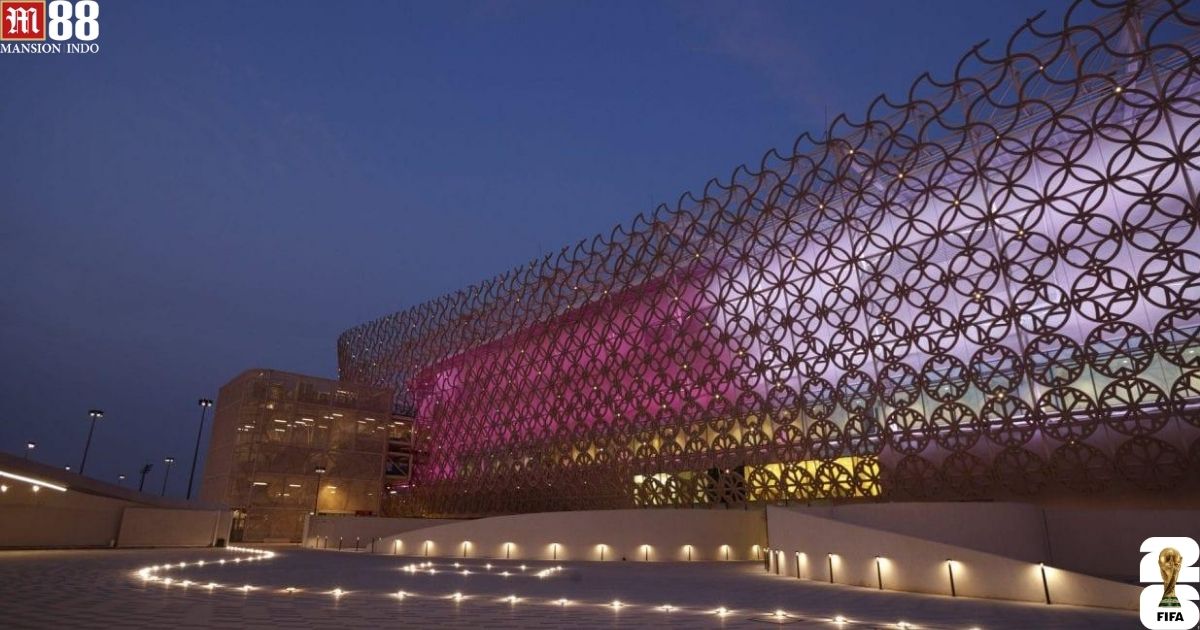
This stadium is the home of Al-Rayyan Sports Club and has a capacity of 40,000 seats. Its exterior design is highly attractive, featuring distinctive Qatari patterns representing family values, flora and fauna, and the beauty of the desert. It is a combination of modernity and local identity.
To ensure spectator comfort, the stadium is equipped with a lightweight canopy and advanced cooling systems.
After the World Cup, its capacity will be reduced to 20,000 seats, and it will return to being the home ground of the local club. The removed seats will be donated for sports development projects in other countries.
6. 2022 World Cup Stadium: Al-Bayt Stadium
With a capacity of 60,000 seats, Al-Bayt Stadium is one of the largest in Qatar. Located in Al-Khor City, about 35 km from Doha, it was selected as the venue for the opening match of the 2022 World Cup.
Its design is highly iconic, resembling a traditional tent of Arab nomadic tribes.
In addition to its unique shape, the stadium is designed with an environmentally friendly concept. Its upper section can be removed, and its seats will be distributed to developing countries after the tournament.
Thus, this stadium is not only grand but also beneficial to many parties.
7. Al-Janoub Stadium
Al-Janoub Stadium is located in Al-Wakrah City, one of the historic cities in Qatar. Its shape is inspired by dhow boats, traditional vessels used by fishermen for pearl diving in the Persian Gulf. It has a capacity of 40,000 seats and was first used in 2019 for the Amir Cup final.
After the World Cup, its capacity will be reduced to 20,000 seats, with the remaining seats donated for stadium construction in other countries.
The surrounding area will also be developed with community facilities such as schools, running tracks, cycling paths, and public spaces.
Thus, this stadium has a long-term future as a center of social life.
8. Al-Thumama Stadium
The final stadium is Al-Thumama Stadium, located 12 km south of Doha. Its design is inspired by the Gahfiya, a traditional cap worn by Arab men.
Its shape is simple yet rich in cultural meaning. It has a capacity of 40,000 seats and was used up to the quarter-final stage.
This stadium also adopts an environmentally friendly concept. With water recycling technology, it can reduce water usage by up to 40 percent compared to typical stadiums.
After the World Cup, its capacity will be reduced to 20,000 seats, and the surrounding area will be developed with parks, hotels, and a mosque.
Closing
These are the eight stadiums of the 2022 World Cup that captured global attention. Each stadium is not only magnificent but also carries added value that allowed Qatar to leave a lasting impression as a host nation.
Some stadiums were built with futuristic designs and modern cooling systems, others are unique due to their dismantlable structures, and some feature designs rich in cultural meaning.
The 2022 World Cup in Qatar is undoubtedly one of the most memorable tournaments in history, not only because of the matches but also because of the spectacular venues.
These stadiums truly prove that football is not only about sport, but also about identity, technology, and cultural heritage.
If you had to choose, which of these eight stadiums do you think is the most impressive and worthy of being called the icon of the World Cup in Qatar?
Latest Article