
16 World Cup Mascots Through the Years
Check out the unique history of World Cup mascots over time, from World Cup Willie to the iconic characters of the 2026 edition.
16 World Cup Mascots Through the Years – m88worldcups.com – Not only does it showcase intense and prestigious football competition.
The World Cup must also demonstrate to the world that the tournament, held every four years, is enjoyable and brings happiness to everyone who watches it. This is where mascots play an important role.
A mascot, with its unique traits and characteristics, is intentionally designed to promote an event and entertain its audience.
However, over time, its role has expanded significantly. It now also serves as an ambassador for the host nation and as a merchandising figure.
The use of official mascots in the World Cup only began in 1966 in England, even though the tournament itself has been held since 1930.
This tradition of using mascots has continued up to the 2026 World Cup in Canada, Mexico, and the United States.
Let us take a moment to look back and get acquainted with all the World Cup mascots throughout history.
World Cup Mascots Through the Years
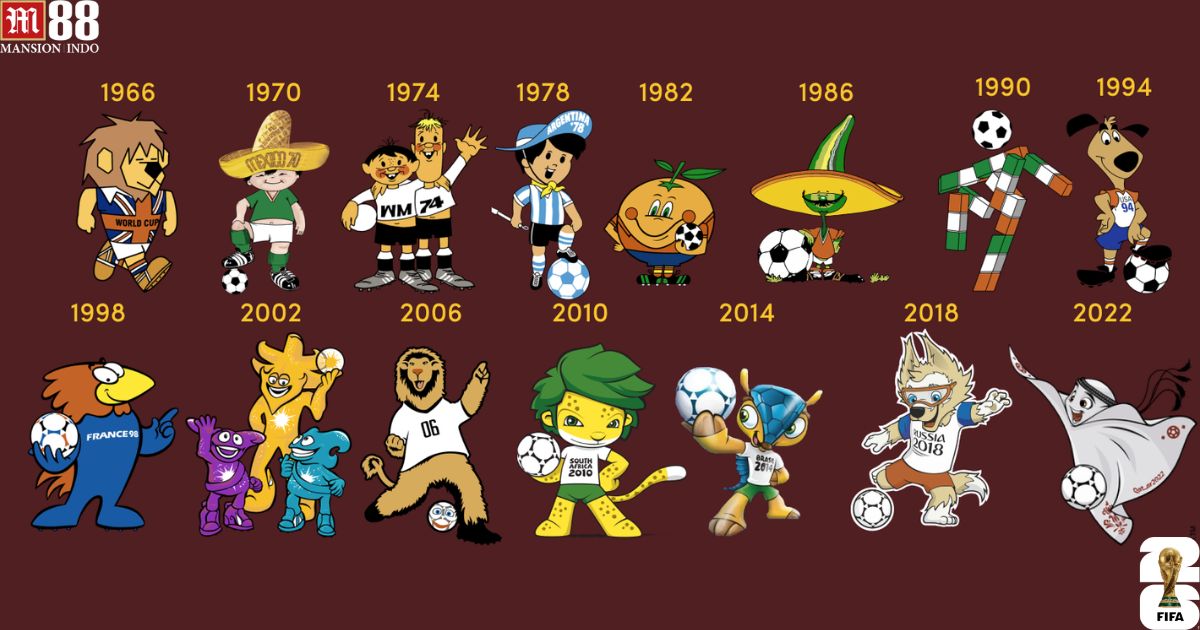
1. World Cup Willie (England 1966)
This was the first World Cup mascot. World Cup Willie was designed by an English children’s book illustrator, Reg Hoye.
The mascot takes the form of a lion, which is also a traditional symbol of the English monarchy, wearing a jersey patterned with the national flag.
Its popularity made World Cup Willie the main character in a comic strip of the same name created by cartoonist Bill Titcombe.
2. Juanito (Mexico 1970)
Unlike its predecessor, this mascot uses a human as its base model. Juanito is depicted as a chubby boy wearing a uniform in the colors of the Mexican flag and a wide sombrero hat with the words “MEXICO 70” on it.
The name Juanito itself is derived from Juan, a common name used in Spanish-speaking countries.
3. Tip and Tap (West Germany 1974)
Tip and Tap were the first mascots consisting of two different characters. Both wear West Germany team jerseys marked with WM and 74.
The term WM stands for Weltmeisterschaft, which translates to World Cup.
Tip and Tap are depicted embracing each other as a symbol of harmony and the spirit of fair play.
4. Gauchito (Argentina 1978)
The design of Gauchito was inspired by the gauchos, or local cattle herders of Argentina. This is reflected in the hat, scarf, and whip, which are part of the traditional attire of gauchos, combined with a striped jersey in the colors of the Argentine flag worn by a young boy.
The name Gauchito is, of course, derived from the word gaucho.
5. Naranjito (Spain 1982)
The name Naranjito comes from naranja, the Spanish word for orange, which matches the overall design of the mascot.
This makes Naranjito the first mascot based on an object rather than a human or animal.
Oranges are a commonly consumed fruit in Spain, making it fitting to dress the mascot in the red and blue jersey of the Spanish team as the symbol of that year’s World Cup.
6. Pique (Mexico 1986)
At the 1986 World Cup, Mexico once again served as host and used a jalapeño chili as the basis for its new mascot design.
The name Pique comes from the Spanish word picante, which can mean pepper or spiciness.
To further emphasize Mexican culture, Pique was given a thick mustache and a sombrero representing the country’s traditions.
7. Ciao (Italy 1990)
Among all World Cup mascots, this is perhaps the most unusual design.
Neither human nor animal, Ciao is a stick figure colored in the Italian national flag with a football as its head.
The word ciao used as its name is an Italian greeting that can mean “hello” or “goodbye.”
8. Striker, the World Cup Pup (United States 1994)
Football is not the most popular sport in the United States. Therefore, the most common household pet in the country, the dog, was chosen as the mascot.
Warner Bros studio was even involved in designing Striker, complete with a red, white, and blue USA jersey, all aimed at attracting audiences in the host nation.
9. Footix (France 1998)
Footix takes the form of a rooster, which is also a national symbol of France, colored in blue and red in accordance with the national flag.
The name Footix comes from the word football, shortened and combined with the suffix -ix, similar to Asterix, a character from a popular French comic.
10. Ato, Kaz, and Nik aka The Spheriks (South Korea–Japan 2002)
The design of this mascot is highly unique. The Spheriks, or the trio Ato, Kaz, and Nik, are entirely CGI creations. Their colors—orange, purple, and blue—enhance their futuristic appearance.
The Spheriks were even given their own animated series. In the story, they are part of an atmoball team, a fictional sport similar to football. Ato serves as the coach, while Kaz and Nik play on the field.
11. Goleo VI (Germany 2006)
Goleo’s design received heavy criticism, with some arguing that a lion does not represent Germany and is instead part of the traditional symbols of England and the Netherlands, which are historical rivals of Germany.
The name comes from the word goal combined with leo, the Latin term for lion. Goleo is always accompanied by Pille, his sidekick, a talking football.
12. Zakumi (South Africa 2010)
As a mascot, Zakumi is distinctly South African. Its base model, a leopard, is an animal commonly found in the southernmost country of Africa. The green and gold colors used are those of the host nation’s national team.
The name Zakumi comes from the country code “ZA” combined with the word kumi, which means ten in various African languages.
13. Fuleco (Brazil 2014)
Through Fuleco, Brazil not only aimed to promote the spirit of football but also to raise environmental awareness.
This is reflected in the choice of the three-banded armadillo, an endemic Brazilian animal that is considered vulnerable due to environmental damage in the country, as the mascot.
The Portuguese words futebol (football) and ecologia (ecology/environment) were combined to form the name Fuleco.
14. Zabivaka (Russia 2018)
This is one of the most recent World Cup mascots, an energetic wolf wearing sporty glasses while playing football.
The creator of Zabivaka, Tomsk State University graphic design student Yekaterina Bocharova, stated that she was inspired by Disney cartoons when creating the mascot.
Translated from Russian, the name Zabivaka means “The Scorer.” There are indeed many mascots in the World Cup, ranging from cute and cool to those that leave you puzzled, all of them are present.
15. La'eeb (Qatar 2022)
The mascot for the 2022 World Cup is named La'eeb. It resembles a cartoon character wearing a white robe with a cute and charming appearance.
La'eeb is an Arabic word meaning a highly skilled player. FIFA also describes La'eeb as a cheerful character who always brings happiness.
Not only that, La'eeb is also associated with courage and is depicted as a mascot that has been present at every World Cup, witnessing history at each tournament.
16. Maple, Zayu, Clutch (Canada, Mexico, and United States 2026)
Finally, there are Maple the Moose (Canada), Zayu the Jaguar (Mexico), and Clutch the Bald Eagle (United States), which were specifically developed to reflect the culture, heritage, and spirit of each respective nation, united to symbolize unity, diversity, and a shared passion for the beautiful game.
Maple, Zayu, and Clutch will also become the first FIFA competition mascots to be playable in a new officially licensed FIFA game, FIFA Heroes.
In addition, FIFA Super League Soccer on Roblox, developed in collaboration with Gamefam, will feature special missions highlighting the role of each mascot on the field, complete with themed rewards.
Looking at the lineup of unique characters above, it is clear that mascots are not merely visual complements, but the soul of the global football celebration.
From traditional lions to digital trios entering the gaming world, each character carries the story and identity of its nation onto the global stage.
Their presence ensures that every edition of the World Cup has a memorable face, entertains across generations, and unites fans from all corners of the world in the same spirit of joy.
Latest Article